
Although data collection is ongoing, preliminary results are available for certain phases and data types. The manual measurement data and some other scalar measures for Phases 1 and 2 are available in our online data browser.
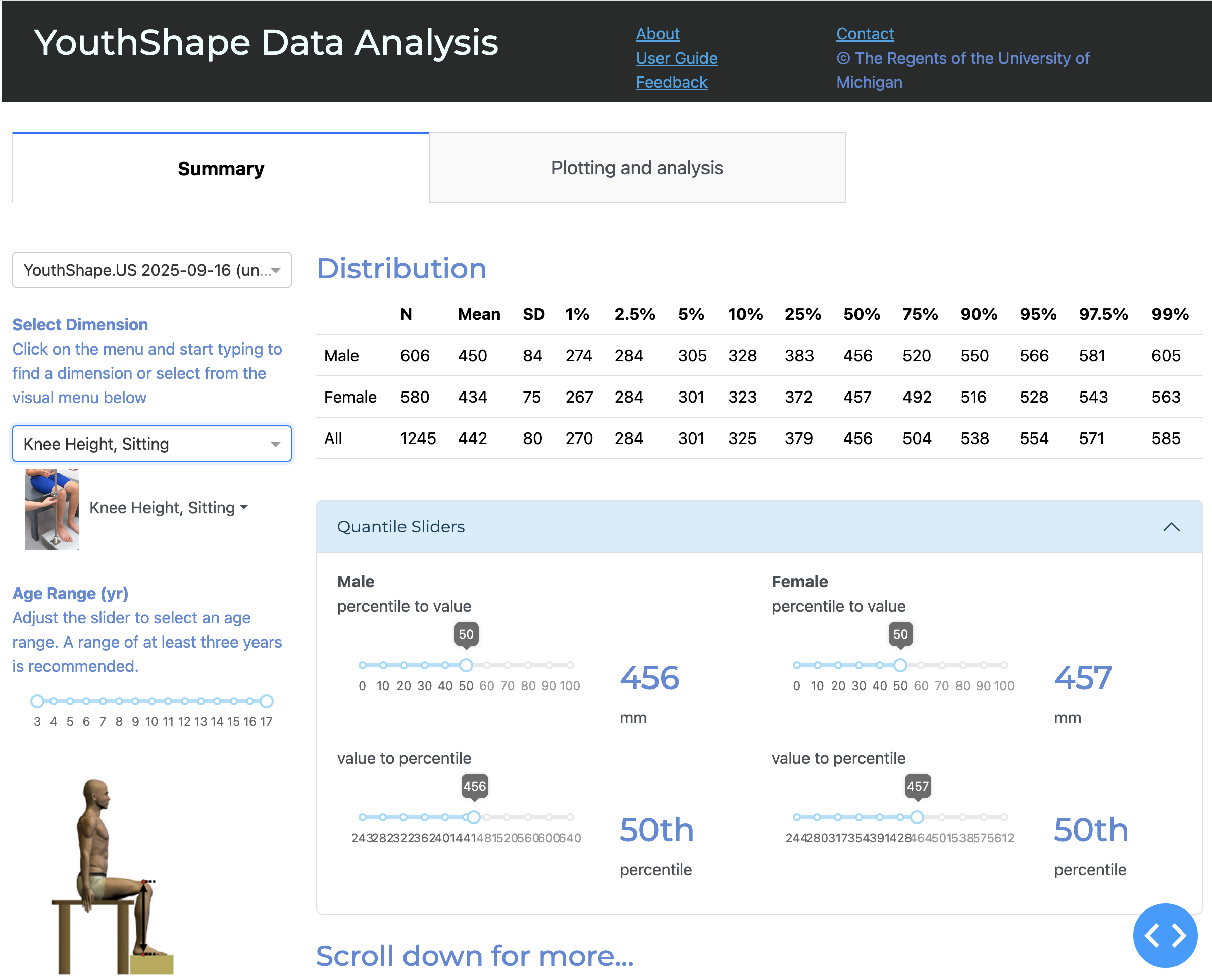
Our web-based data browser provides interactive visualization and analysis tools for exploring the YouthShape dataset without requiring data download or special software. The YouthShape.US data browser provides a visual index to dimensions and automatically computes typical statistics. Interactive calculators convert values to percentiles for any dimension, and quantiles are automatically computed for each one-year age cohort for male and female youth.
For more detailed documentation on using the data browser, please refer to the User Guide.
Feedback and suggestions for additional features are welcome; please contact us.
Launch Data Browser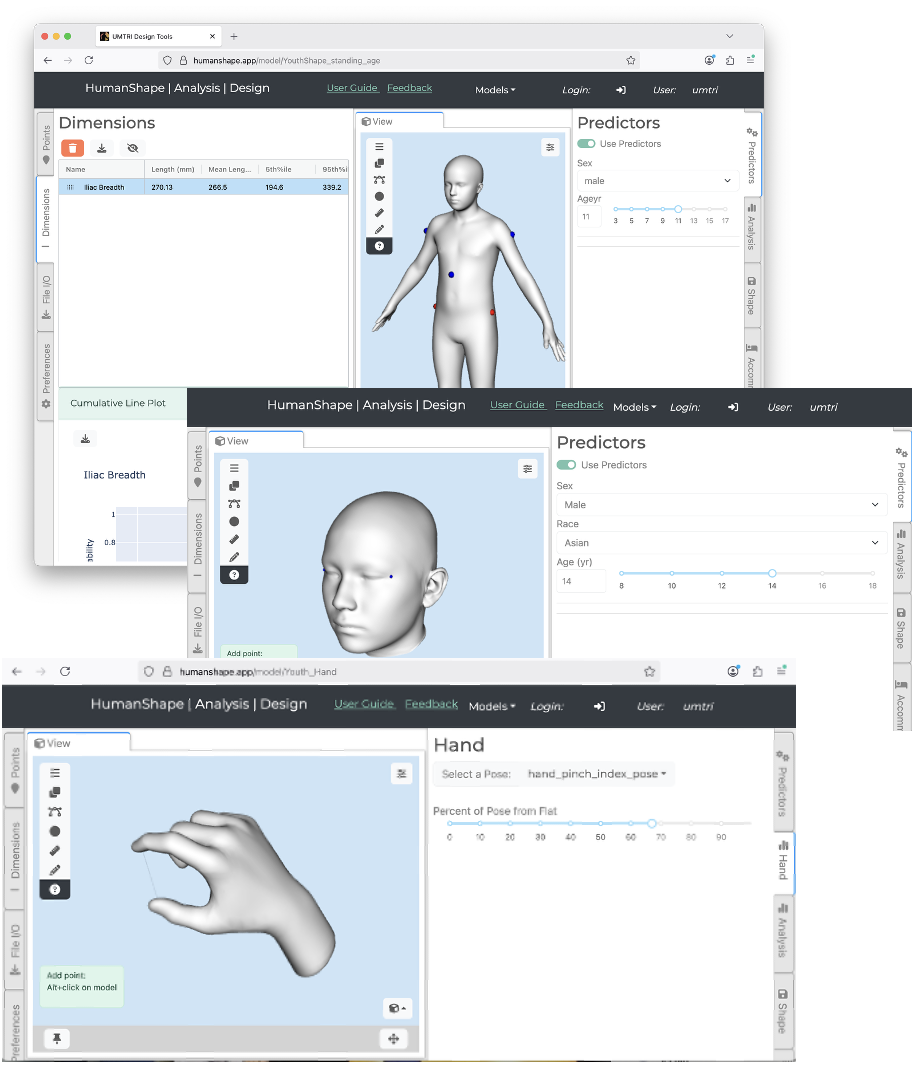
We are integrated the statistical shape models developed in YouthShape.US into our new online anthropometry app. The HumanShape app provides unprecedented functionality for interacting with 3D data, enabling designers to generate body shapes with a wide range of input parameters, define and measure new dimensions across the population, compute quantiles for novel measures, and conduct many other analyses. Contact us for more information or to become a beta tester.
Contact UsThe data browser is free to use for internal research and development purposes with a click-through end-user license agreement. Note that outputs from the browser, such as summary tables and plots, are for R&D use only and may not be published in any form. If you have questions or suggestions, or would like to use these results in a different way, please contact us.
The research team works closely with industry to provide quantitative guidance for product design based on anthropometric data. If you have a design or safety problem you'd like to discuss, please contact us.
The YouthShape dataset has a rich range of data linking body habitus to physical activity and body composition. Academic researchers interested in collaboration should contact us.
We are working with industry and academic partners on a range of applications. Some of the applications of the data are listed below. If you have ideas for a collaboration or case study, please contact us.
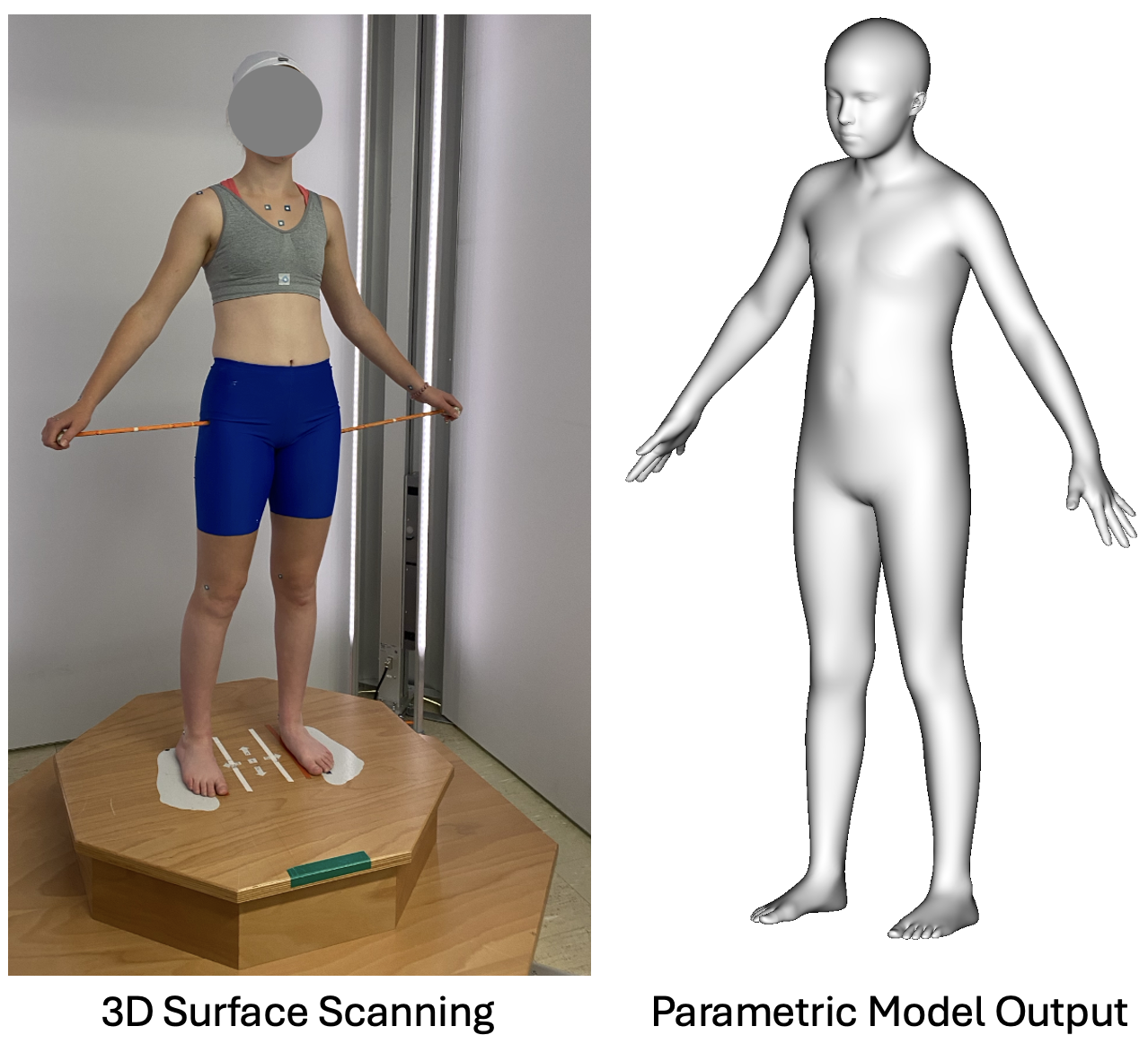
Data: body dimensions, body shape
The YouthShape dataset integrates manual one-dimensional measurements with 3D whole-body surface scans. The data demonstrate the broad range of body size across age, sex, and race/ethnicity. The important effects of increasing body mass on body size and shape are evident in the data.

Data: head shape, head dimensions
The YouthShape dataset includes detailed 3D head scan data that provide valuable guidance for the design of sports helmets that fit children better. The scalar data browser provides access to traditional measures of head length, breadth, and circumference that can be stratified by age and sex.
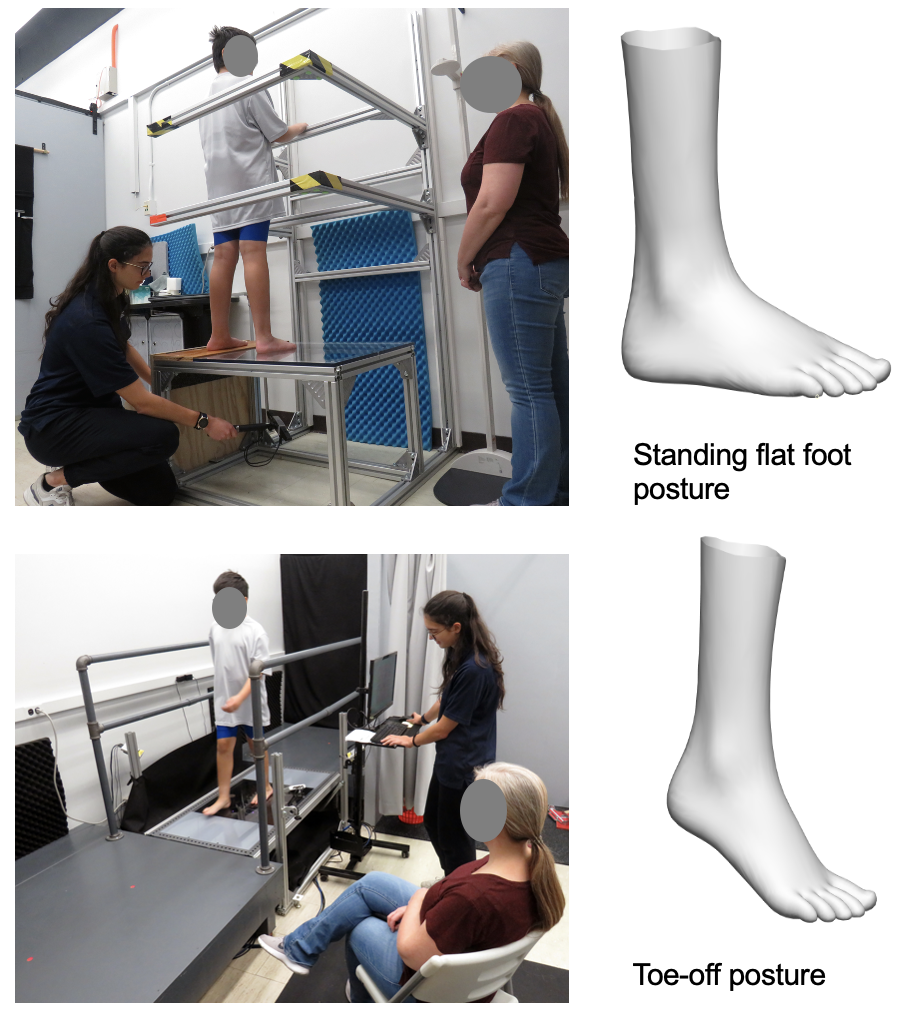
Data: foot shape, foot kinematics
The YouthShape study produced the first ever parametric model of U.S. children's feet. We found a strong effect of BMI on foot shape, demonstrating that the shoe lasts used for previous generations are no longer appropriate. We also have developed the first-ever 3D model of children's feet in motion, documenting in detail the patterns of foot motion through a gait cycle.
Read the Journal ArticleYouthShape methods, outcomes, and applications
Human Factors. Published online. doi:10.1177/00187208261478468
Accurate anthropometric data are essential for designing products that safely accommodate children. The most comprehensive U.S. child anthropometry survey was conducted in the 1970s and no longer reflects current populations. Phase 1 of YouthShape.US collected laboratory data from 650 children aged 3–17 years, who completed a standardized protocol of 57 manual anthropometric measurements in standing and seated postures, along with body-composition measures. Body weight and waist circumference were substantially larger than values reported in the 1970s, and buttock–knee length was also larger, indicating changes in seated body dimensions relevant to product and environment design. YouthShape.US establishes the first large-scale, detailed, publicly accessible anthropometric resource for U.S. children and adolescents in more than five decades.
View PublicationApplied Ergonomics, 134, 104741. doi:10.1016/j.apergo.2026.104741
The most important anthropometric change in the U.S. in recent years is the increase in body mass at every age, but the effects of these trends on child foot shapes have not previously been studied. We collected high-resolution, three-dimensional foot surface data from 490 children ages 3–17 years across body mass index (BMI) from 12.4 to 52.6 kg/m² and developed a statistical foot shape model to analyze the variations in foot morphology related to BMI. After accounting for age effects, a higher BMI was associated with broader foot width, greater circumference, increased thickness, larger cross-sectional area and volume, and lower arch height. The findings suggest that the increasing body mass among children may necessitate the redesign of footwear to ensure a good fit. The children's foot model is publicly available online at HumanShape.org/ChildFoot.
View PublicationIn Proceedings of the Human Factors and Ergonomics Society Annual Meeting. Sage Publications, Los Angeles, CA.
Understanding the range of body sizes and shapes among children is critical for the design of products and systems to ensure safe and effective use and other safety considerations to reduce the risk of injury. The availability of useful data for youth is even more limited than for adults. To address this gap, methods were developed to gather detailed, integrated, three-dimensional (3D) data on anthropometry and to characterize the physical capability of children from ages 3 through 17 years. This paper provides an overview of the methods developed in a pilot study.
View Publication