Updates

2026

September 2026

YouthShape.US: Overview Article Published

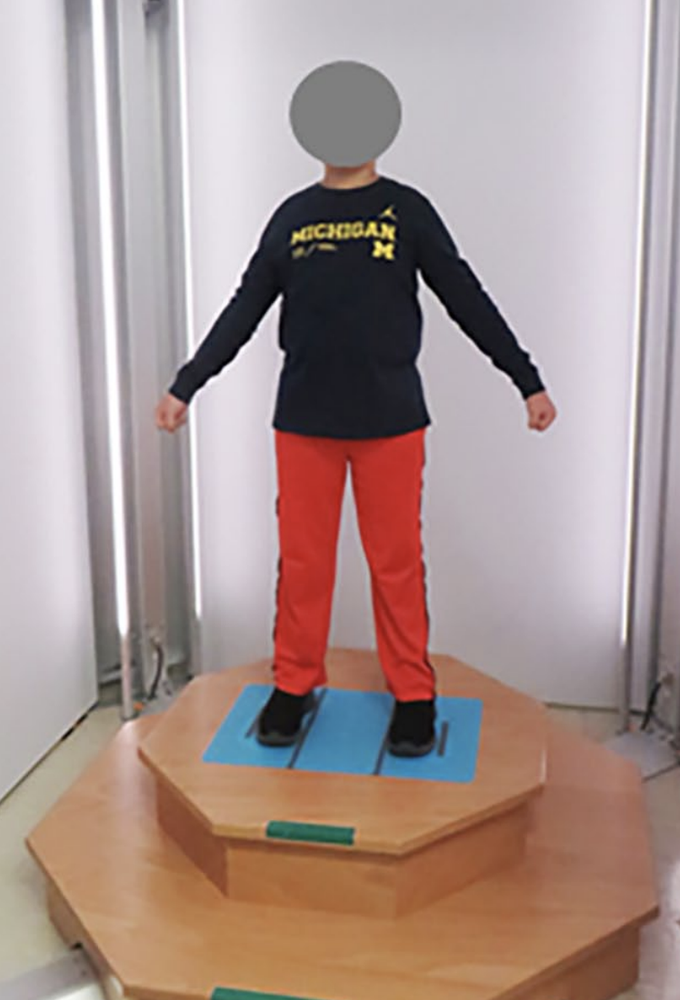
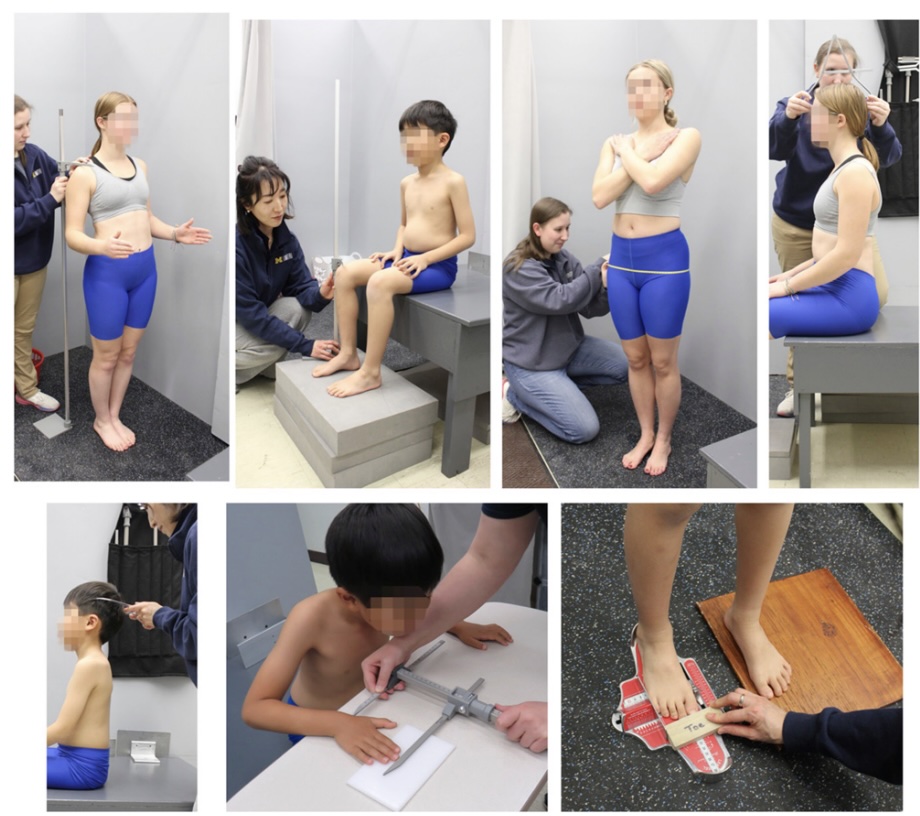
The initial overview journal article from YouthShape.US has been published. We are proud to be wrapping up the largest and most comprehensive anthropometric survey of U.S. children since the 1970s. This paper focused on the Phase-1 laboratory measurements, with a summary of the methods and an illustration of how much has changed in the last 50 years, mainly due to increases in body weight at every age. A companion technical report includes the details of the manual measurements, summary statistics, and plots for the initial phase of data collection. YouthShape.US is unique in many ways, among them that we have gathered a large number of manual measurements in addition to the 3D scans of the whole body, hands, head, and feet. The manual measurements provide a direct linkage to earlier studies and provide a mapping from 3D scan-based measurements to the traditional dimensions used in the design of clothing and other products. For much more on the study, see YouthShape.US
March 2026

First Article from YouthShape.US!

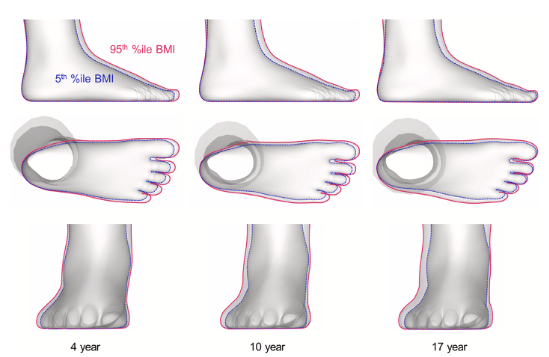
Our first journal article based on the YouthShape.US anthropometry study has appeared! We are delighted that this outstanding work led by our post-doc Hayoung Jung has been published, presenting an exceptionally high-resolution, accurate statistical shape model of the pediatric foot. We looked at the effects of BMI on foot shape and found important effects that call into question the utility of existing shoe lasts. Bottom line, the upper quantiles of foot volume at a given length are much higher than they used to be. It's likely that many kids are walking around in shoes that are far too long for them just to have enough space vertically and horizontally. This new model will provide guidance for footwear design, but is also part of a larger program to bring large-scale virtual fit testing with avatar populations (not just a few cases!) to general product design. Check out HumanShape.app for more on this.

A second note: As you are probably aware, journal reviewing is broken -- too many people submitting far more papers than they are qualified to review (and reviewing even fewer). This article took about 14 months to get through review, in spite of edits being minor. Folks: (1) do not accept an article to review that you can't get done in two weeks, (2) actually do the review in the allotted time, and (3) remember that you are obligated to review 3 times as many papers as you submit! That's the way the system works: if each paper has three reviewers, you need to review a minimum of 3x more papers than you publish!

January 2026

YouthShape.US Advances

We continue to make rapid progress on YouthShape.US, the first large-scale, publicly accessible anthropometric survey of U.S. children since the 1970s. The freely available scalar data browser now hosts data from over 3500 children measured at multiple sites. The website provides summary statistics by sex and age, enables bivariate analyses, and gives rapid conversion between values and percentiles for any of the measures. In the next few months we will roll out demo access to our 3D tools based on HumanShape data. We've recently enhanced our standing child model so that we're covering ages 3 to 17 years with data from over 2300 children and youth. This is the most advanced and accurate child body shape model available and we're continuing to innovate, adding new analysis features. Most importantly, we're rolling out a synthesized dataset that uses advanced statistical techniques to generalize from our study population to the entire U.S. population. Check YouthShape.US for more updates!

2025

October 2025

YouthShape.US Launched!

We launched the home website for YouthShape.US this month. This is the first large-scale, publicly accessible anthropometric study of U.S. children in 50 years. The study is being conducted in three phases. In the first phase, completed in 2024, we conducted very detailed measurements of body size, shape, strength, composition, and physical activity for 650 children from ages 3 to 17 years. In Phase 2, just completed, we added more than 600 Black and Hispanic children and youth to enhance the breadth of representation in the sample. We are about halfway through Phase 3, in which we're gathering 3D data from more than 3000 children at multiple sites. One goal of the study is to make the outcomes available online, going far beyond the traditional tabular presentations of quantiles. The initial version of the scalar data browser includes data from over 1000 children, and supports computation of summary statistics as well as bivariate analyses. Much more capability will be coming in future iterations. Check out the website for more information about the study.

2024

October 2024

Methods for YouthShape.US at HFES

My colleague Dr. Monica Jones presented a paper at the annual conference of the Human Factors and Ergonomics Society describing the methods for our YouthShape.US survey. As of Fall 2024, we have gathered very detailed body size, shape, strength, and physical activity data from over 650 children and adolescents ages 3 to 17 years. This extremely rich dataset includes over 50 manual anthrometry measures, high-resolution 3d surface scans of the head, hands, feet, and whole body dozens of postures, as well as grip strength, lower extremity power, body composition, and many other measures. This dataset is already the richest child anthropometry dataset in the world, and yet is only the pilot study for what will be a study of over 4000 children and youth by the end of 2026.